

SEND Information
Oakbank School is ambitious for all our pupils, and we believe that there is no ceiling on what can be achieved by anyone, regardless of their circumstances or background. We are committed to providing a supportive and inclusive learning environment, giving every young person the opportunity to fulfil their potential now, and in the future.
The leaders at Oakbank School are leaders for all pupils, enabling our teachers to be teachers of all pupils. Oakbank School is committed to distributed leadership to secure the best possible provision and outcomes for pupils with special educational needs. We have the same ambition for all our pupils, and recognise the importance and impact of prioritising our responsibilities to pupils with special educational needs.
We work in partnership with pupils and their families in identifying and providing for special educational needs. Where appropriate, we also work in partnership with other agencies. We recognise the importance of communication being inclusive, accessible and culturally sensitive to achieve effective partnership working.
Graduated response
|
Stage |
Provision required |
Support and provision |
Assessment, recording and monitoring systems |
|
1
|
Universal provision |
|
|
|
2 |
Early intervention support
|
In addition to Stage 1:
|
|
|
3 |
Targeted, additional support
|
In addition to Stages 1 - 2:
|
|
|
4 |
Targeted, intensive additional support |
Consider request for EHC Plan (at least two cycles of APDR required) In addition to Stages 1 – 3:
|
|
|
5 |
Provision over and above Stage 4
|
In addition to Stages 1 – 4:
|
|
What does it mean to have a Special Educational Need?
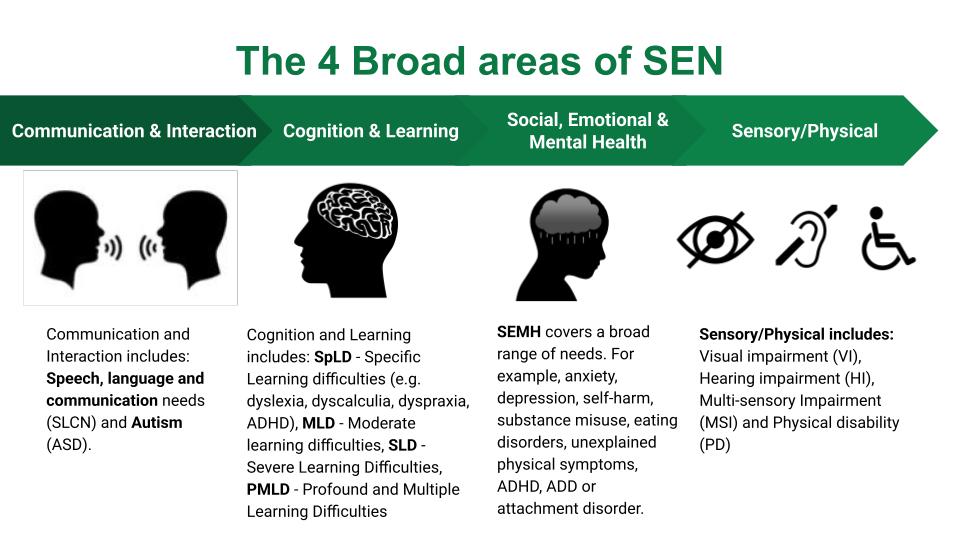
A pupil has SEN if they have a learning difficulty or disability that requires special educational provision to be made for them.
They have a learning difficulty or disability if they have:
-
A significantly greater difficulty in learning than most others of the same age; or
-
A disability that prevents or hinders them from making use of facilities of a kind generally provided for others of the same age in mainstream schools.
Special educational provision is educational or training provision that is additional to, or different from, that made generally for other children or young people of the same age by mainstream schools.
At Oakbank, we are committed to ensuring that all students receive an education that enables them to grow as successful learners and members of our community.
We work hard to provide effective support to students with Special Educational Needs and Disabilities, starting from our first contact with parents and carers when students join our school.
We make sure that additional needs are identified early and offer a range of provision to meet the identified needs. We identify Special Educational Needs and Disabilities (SEND) in a variety of ways, including:
-
Discussions with primary schools and parents on transition.
-
Assessment of reading age and levels upon entry.
-
Assessment for any specific learning needs upon parental request.
-
Pupil passports for the continued support of students with additional needs.
-
Close monitoring of both academic and emotional capacity.
-
Parental/carer request.
-
Notification from outside agency
Our SENDCO
Katherine Reggler, SENDCO
I am fully dedicated to ensuring educational equity for all our students at Oakbank School. I believe with the right support, teamed with access to high-quality teaching and learning, every child can climb their personal mountain to the careers, colleges and universities of their choosing.
Identification and Assessment of Children with SEND
A pupil has SEN where their learning difficulty or disability calls for special educational provision, namely provision different from or additional to that normally available to pupils of the same age (SEN Code of Practice, 2015).
A learning difficulty is a significantly greater difficulty in learning than the majority of others of the same age.
A disability that requires special educational provision is a disability that prevents or hinders the pupil from accessing the educational provision generally provided for others of the same age.
Not all pupils with a disability will be identified as requiring special educational provision. Appropriate reasonable adjustments will be made to ensure we remove or prevent barriers experienced by all pupils with a disability.
Parents/carers are informed when pupils are added to or removed from the SEN register. When deciding whether special educational provision is required, we will start with the desired outcomes, including the expected progress and attainment, and the views and aspirations of the pupil and their parents/carers.
We will use this to determine the support that is needed and whether this can be provided by adapting our core offer, or whether something additional is needed.
We work in close partnership with families and local settings. Many pupils with special educational needs will therefore be identified through the transition and induction process.
On entry, we assess each pupil’s current skills and levels of attainment, which will build on previous settings and Key Stages, where appropriate.
Class teachers make regular assessments of progress for all pupils and identify those whose progress:
-
Is significantly slower than that of their peers starting from the same baseline
-
Fails to match or better the child’s previous rate of progress
-
Fails to close the attainment gap between the child and their peers
-
Widens the attainment gap
-
Demonstrates high levels of dysregulation
This may include progress in areas other than attainment, for example, social needs. Attendance and behaviour data might also be used to identify which pupils require additional support.
Slow progress and low attainment will not automatically mean a pupil is recorded as having SEN.
Where a parent/carer has a concern about their child, parents are asked to speak with the SENCO so that appropriate observations and assessments can be undertaken.
Pupil Passport
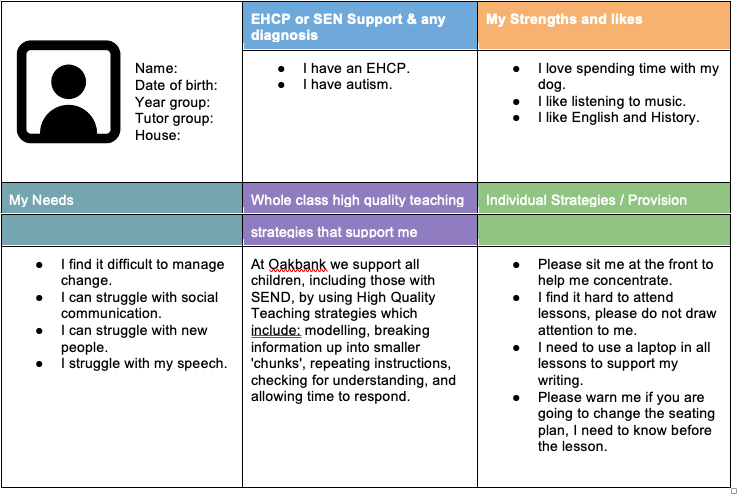
A pupil passport is a regularly reviewed document that contains the needs, strengths and individual strategies for every student with an EHCP or on SEN Support. These are developed in partnership with pupils and their parents/carers. Where appropriate, they might also include strategies recommended by other professionals.
GLT Pupil Passport Template - Oakbank
Pupil Profile – Oakbank School
Universal provision – high quality teaching
Oakbank School ensures that a universal provision of high quality teaching is able to address gaps in foundational knowledge and skills. Through evidence-informed classroom routines and a well-planned curriculum, teachers are able to address reading fluency and accuracy, communication and language skills, writing composition and number facts. Furthermore, our carefully selected and sequenced curricula ensure foundational subject-specific knowledge is secure at every step. For some students, effective in-classroom targeted support ensures gaps are identified and tackled quickly through our responsive and adaptive classroom practice.
Targeted support
In addition to the universal provision of high quality teaching, targeted support is given to specific pupils to help them to overcome barriers to learning. Pupil Passports outline individual strategies and provisions to support learning, such as adjustments to seating, use of a laptop or reminders to check understanding. There are also targeted interventions such as ‘Read, Write Inc Fresh Start’, a phonics programme designed to improve reading skills in secondary school pupils.
Specialist support
At Oakbank, we work in partnership with a range of external agencies such as educational psychologists and speech and language therapists. They may assess individual students and suggest further recommendations and additional support.
Staff training
At Oakbank School, staff receive regular training on the techniques used to ensure there is high quality teaching and excellent universal provision. Teachers are trained to become experts in the following teaching techniques:
-
High frequency retrieval practice, meaning we ask children to remember what they have learned (mini white boards, low stakes quizzes and cold calling).
-
Chunked explanations with frequent opportunities for teachers to check student understanding.
-
Independent practice, which allows students to consolidate and practise their knowledge, and gives teachers the opportunity to provide feedback.
There are regular ‘Spotlight on SEND Sessions’ where the needs of individual students and the strategies to support them are clearly explained and teachers are trained in specific areas of SEND.
Useful links
Teacher Handbook: SEND
With contributions from specialists across the sector, the handbook is a comprehensive resource for teachers and parents to use over time. It brings together practical examples of high-quality teaching – placing focus on removing barriers to learning, getting to know and understand individual learners, and bringing to life the graduated approach. To access this free resource, click on the link below and sign up to Whole School SEND:
Whole School SEND Online CPD Units
Free, flexible online learning to help develop inclusive practice.
The link to the SEN Policy and SEN Information Report can be found here.
The link to the Local Offer can be found here.